
Brampton strong mayor powers let the mayor propose the City budget, hire the chief administrative officer and senior managers, and veto some by-laws, under Ontario’s Municipal Act. Brampton has had these powers since July 1, 2023, so whoever wins the mayor’s race on October 26, 2026 will hold them. This guide covers what the powers include, what council can still do, and the new limits that apply around this election. For how those powers fit with council’s role, see the key areas Brampton’s mayor controls.
At a glance
- Since when: July 1, 2023, when Ontario added Brampton to its list of strong mayor municipalities, the City says.
- Budget: the mayor must propose the City budget by February 1 each year. Council can amend it, the mayor can veto amendments, and council can override a veto with a two-thirds vote.
- Staff: the mayor can appoint the chief administrative officer, hire most department heads and reorganize City departments.
- By-laws: the mayor can veto some by-laws, or push some through with the support of more than one-third of council, but only when tied to provincial priorities on housing and infrastructure.
- Transparency: every use of these powers must be in writing and made public.
- Voting: see our guide to voting in Brampton’s 2026 election for dates, ID and locations.
Table of Contents
Brampton strong mayor powers: the basics
Strong mayor powers are extra powers and duties that Ontario gives the head of council in designated municipalities. They sit in Part VI.1 of the Municipal Act, 2001, created by the Strong Mayors, Building Homes Act, 2022 and expanded by the Better Municipal Governance Act, 2022.
The province first gave the powers to Toronto and Ottawa. It has since extended them to many more municipalities. Brampton, Mississauga and Caledon are all on the current list in Ontario Regulation 530/22.
The province ties several of the powers to what it calls provincial priorities. The regulation lists two: building 1.5 million new homes by December 31, 2031, and building and maintaining infrastructure to support housing, including transit, roads, utilities and servicing.
The budget: the mayor proposes, council can amend
The biggest change is the budget. In a strong mayor city, the mayor writes the proposed budget, not council. Ontario’s municipal councillor’s guide sets out the steps:
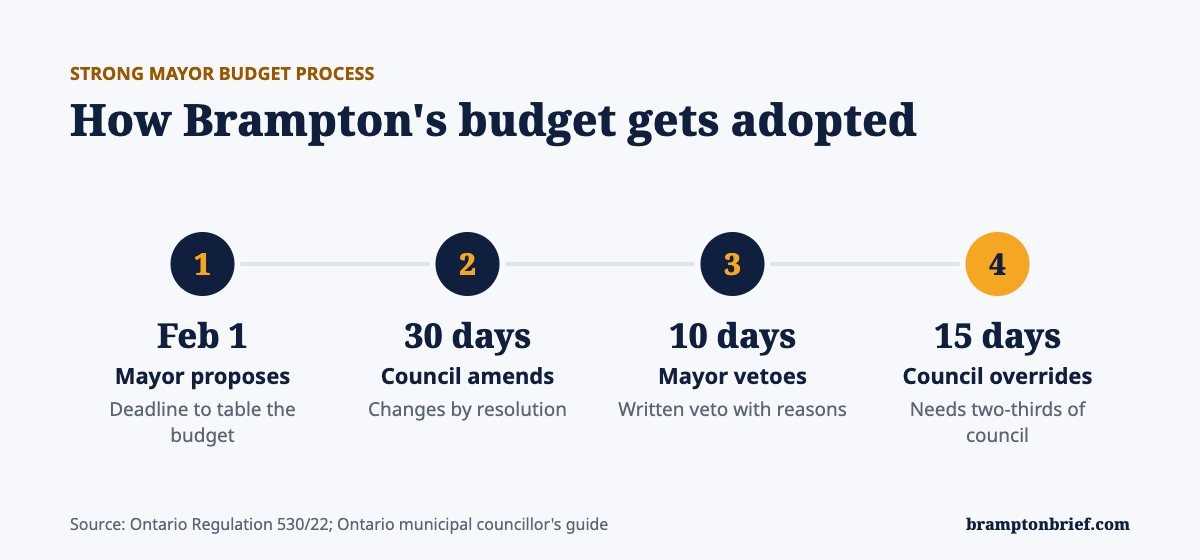
- By February 1: the mayor proposes the budget and makes it public. If the mayor misses the deadline, council prepares and adopts the budget itself.
- 30 days: council can amend the proposed budget by resolution.
- 10 days: the mayor can veto any council amendment, in writing with reasons.
- 15 days: council can override a veto if two-thirds of all members vote to do so.
When the steps run out, the budget is deemed adopted. Council can vote to shorten its own periods, and the mayor can shorten the veto period.
There is a separate, shorter process for in-year amendments that raise more property tax: 21 days for council, 5 days for a mayoral veto and 10 days for an override.
The budget sets your property tax. Our Brampton property tax explainer shows how your bill is calculated.
Hiring and running City Hall
The mayor can appoint the chief administrative officer, the City’s top staff member. The mayor can also hire most department heads and change how City departments are organized.
Some jobs are excluded. The province’s list includes the clerk, treasurer, integrity commissioner, ombudsman, auditor general, chief building official, police chief, fire chief and medical officer of health.
The mayor can create committees made up only of council members, decide what they do and appoint their chairs and vice-chairs. The mayor can hand some of these powers back to council or to the chief administrative officer.
Vetoes and by-laws tied to housing
These two powers only apply when the mayor believes a by-law affects a provincial priority.
Veto. If council passes a by-law that the mayor believes could interfere with a provincial priority, the mayor can veto it. The mayor must give notice within two days of the council vote and issue the written veto within 14 days. Council can override the veto within 21 days with a two-thirds vote of all members.
Proposing by-laws. If the mayor believes a by-law could advance a provincial priority, the mayor can require council to vote on it. Such a by-law passes if more than one-third of all council members vote in favour. The mayor can vote too.
Both powers cover only certain types of by-laws, such as those under the Municipal Act and the Planning Act. Procedure by-laws are excluded.
How Brampton’s mayor has used the powers
The City publishes every use of Brampton strong mayor powers as a written decision on its mayoral decisions page, numbered by year. Two examples:
- Decision 2024-023 (December 4, 2024): created a new Budget Division in the Finance Department, led by a Chief Budget Officer who reports to the mayor on the capital and operating budgets.
- Decision 2026-009 (May 6, 2026): added a closed-session item on road safety initiatives to that day’s council agenda.
You can read every decision on the City’s page.
What changes around the October 26 election
A 2026 change to Ontario’s regulation (O. Reg. 189/26) adds limits on the mayor during an election.
Once it can be determined that the incoming council will have a different mayor, or that fewer than three-quarters of the outgoing council will return, the outgoing mayor cannot:
- appoint a chief administrative officer
- reorganize City departments
- use the by-law power to approve selling City property worth more than $50,000, or spending or liabilities over $50,000, unless it was already in the most recent budget adopted before nomination day
After voting day, that decision is based on the declared results. Emergency powers are not affected.
The same 2026 change affects next year’s budget. For the year right after a regular election, the mayor can propose the budget only in that year. In practice, Brampton’s 2027 budget can only be proposed in 2027, by the mayor who takes office after this election.
The winners serve from November 15, 2026 to November 14, 2030.
What this means for you
With Brampton strong mayor powers in place since July 2023, the mayor’s job reaches further than it did before. The person you elect writes the first draft of the City budget, picks the City’s top staff and can override council on some housing and infrastructure decisions. Council still has a real check: it can amend the budget and, with a two-thirds vote, override a veto. That makes the councillors you elect in your ward matter too.
The City’s ballot lists 12 candidates for mayor. You can see them in our list of Brampton mayor candidates, and the councillor candidates in your ward are listed by ward pair. Brampton Brief does not endorse any candidate.
FAQ
Does Brampton have a strong mayor?
Yes. The City says Brampton was added to Ontario’s list of strong mayor municipalities effective July 1, 2023.
Can Brampton council override the mayor?
Yes, on budget amendments and by-law vetoes, if two-thirds of all council members vote to override.
Can the mayor pass a by-law with only a third of council?
Only by-laws the mayor proposes to advance a provincial priority, such as housing. These pass with more than one-third of all council members in favour.
Who proposes Brampton’s 2027 budget?
Under the 2026 rule change, the 2027 budget can only be proposed in 2027, by the mayor elected on October 26, 2026.
Where can I see how the mayor used these powers?
On the City’s mayoral decisions page, which posts each written decision.
This article is general information, not legal advice. For the full rules, see Part VI.1 of the Municipal Act, 2001 and Ontario Regulation 530/22.