

Brampton mayor powers cover leadership, the City budget, senior administration and certain decisions tied to provincial priorities, while Brampton City Council makes decisions on municipal services and policy. The split matters as residents prepare to vote on October 26, 2026. Use this guide alongside Brampton Brief’s 2026 voting guide to understand which level of government is responsible for the issue you want changed.
At a glance
- Mayor: leads Council, has specific “strong mayor” powers under Ontario’s Municipal Act, 2001, and proposes the City’s annual budget.
- City Council: sets municipal policy, approves or rejects committee recommendations, makes budget decisions within the legal framework and oversees City services.
- City of Brampton: manages local roads, Brampton Transit, fire services, parks, recreation, by-law enforcement, planning and other local services.
- Region of Peel: remains responsible for services including Peel Regional Police, paramedic services, public health, regional roads, water and wastewater, housing and social services. Current waste arrangements are more specific: see the section below.
- Ontario and Canada: control major responsibilities such as hospitals, education legislation, provincial highways, immigration, citizenship and criminal law.
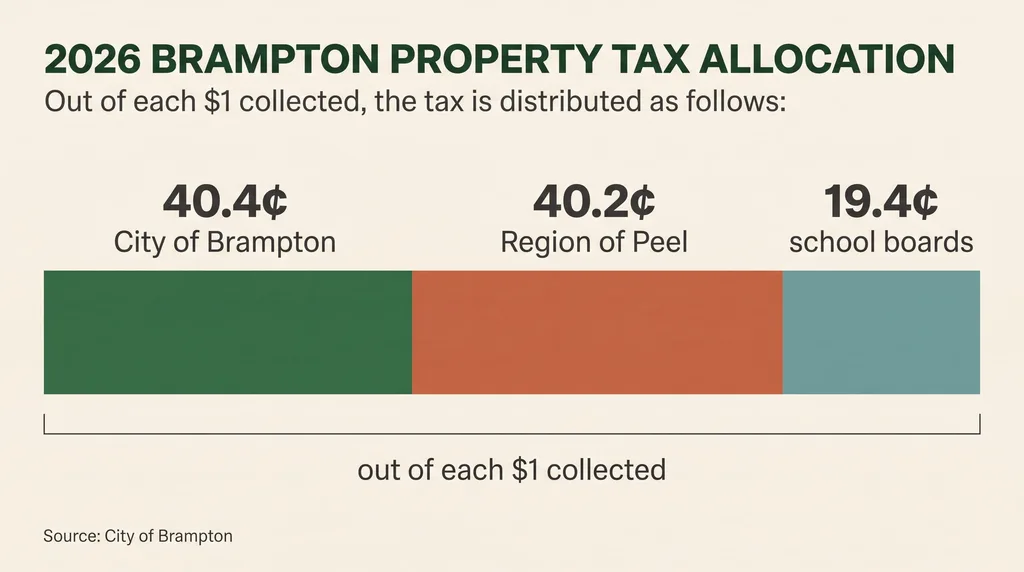
- Property taxes: in Brampton’s 2026 breakdown, every $1 collected is allocated 40.4¢ to the City, 40.2¢ to Peel Region and 19.4¢ to school boards.
Table of contents
- Brampton mayor powers: What the law allows
- What does Brampton City Council control?
- How are Brampton property taxes divided?
- What does Peel Region control?
- What is controlled by Ontario or the federal government?
- How can Brampton residents influence a decision?
- Frequently asked questions
Brampton mayor powers: What the law allows
The Mayor of Brampton has the usual leadership responsibilities of a head of council, plus special powers provided by Ontario’s strong-mayor legislation. The City says those special powers include appointing the Chief Administrative Officer, hiring or reorganizing senior administration, creating certain Council committees, proposing the annual budget and using specified powers involving by-laws connected to provincial priorities.
Brampton has been covered by Ontario’s strong-mayor framework since July 1, 2023. The City’s Mayoral Decisions page explains the current powers and publishes written mayoral directions and decisions.
The special powers are not unlimited. The law sets out when specific powers can be used, including rules about the budget, by-law vetoes and prescribed provincial priorities such as housing and infrastructure that supports housing. The mayor may delegate certain powers. Residents should check the City’s published decisions and the legislation instead of assuming a campaign promise could be implemented by the mayor alone.
Understanding Brampton mayor powers starts with separating the authority written into provincial law from the broader influence a mayor has as the public face of City Hall. The mayor can set priorities, lead discussions and use powers provided by law, but does not personally run every public service or replace every decision-making process. Many issues still involve Council, City staff, another level of government or a combination of them.
What does Brampton City Council control?
Brampton City Council is the City’s decision-making body for municipal matters. Under section 224 of Ontario’s Municipal Act, 2001, council represents the public, develops and evaluates municipal policies and programs, determines the services the municipality provides, supports transparent administration and maintains the municipality’s financial integrity.
The City’s Council and Committees page explains that committees discuss issues and public input before making recommendations. Council then decides whether to approve or reject those recommendations. That means residents should look at Council reports, agenda items, votes and approved budgets when assessing whether a proposed change has moved forward.
Services mainly managed by the City of Brampton
| Issue | What City Hall can influence | Important limit |
|---|---|---|
| Brampton Transit | Local transit service planning, fares and the municipal transit budget | GO Transit and wider regional transportation infrastructure involve other agencies and levels of government. |
| Local roads and snow removal | City-maintained roads, local road operations and snow-removal service | Regional roads and provincial highways may be managed elsewhere. |
| Fire and emergency services | City fire services, prevention and related municipal resources | Ambulance services and police services are separate responsibilities. |
| Parks, recreation and culture | Parks, recreation facilities, libraries and local cultural programming | A particular project still depends on budgets, approvals and operating plans. |
| Planning and development | Local planning decisions, zoning processes and neighbourhood development policy | Provincial law, plans and appeal processes can shape what the City may approve. |
| By-law enforcement | City by-laws, local standards and enforcement priorities | A complaint must fall within City jurisdiction; other agencies handle other matters. |
The City’s official government responsibilities guide lists these municipal services. For a resident deciding whom to contact, the first check is whether the issue concerns a City-maintained service or a service assigned to Peel Region or the Province. That division also sets a practical limit on Brampton mayor powers: the mayor cannot take over a service simply because residents want a different outcome.
How are Brampton property taxes divided?
Brampton’s 2026 property-tax breakdown shows why a change to the City’s tax rate does not necessarily mean the same percentage change to the whole property-tax bill. For every dollar collected, the City says 40.4 cents funds the City of Brampton, 40.2 cents goes to Peel Region and 19.4 cents goes to school boards. The City collects these components together, but each funds a different part of local government.
| Recipient | Share of each $1 collected in 2026 |
|---|---|
| City of Brampton | 40.4¢ |
| Region of Peel | 40.2¢ |
| School boards | 19.4¢ |
The City also breaks down its 40.4-cent share. Its 2026 figures allocate 9.8 cents per dollar to capital infrastructure, 8.6 cents to transit, 7.8 cents to fire and emergency services, 5.5 cents to public works, 3.6 cents to recreation and culture, 2.8 cents to parks and pathways, 1.6 cents to the library and 0.4 cents to enforcement. The City notes that the parts may not total exactly because of rounding.
For 2026, Brampton approved a 0% increase to the City’s portion of the property-tax bill and a 1% levy dedicated to the City’s second-hospital reserve. These are two separate details: the 0% figure refers to the City’s tax-rate increase, while the levy is a dedicated contribution toward the City’s provincially required $125-million commitment to William Osler Health System. Hospital operations remain a provincial responsibility; Brampton’s financial contribution does not give City Council control over hospital operations.
Read Brampton Brief’s property tax explainer for more context, and use the City’s official 2026 budget page for budget documents and updates.
What does Peel Region control?
Peel Region is responsible for services that cover Brampton, Mississauga and Caledon, including paramedic services, public health, housing and social services, regional roads, water and wastewater, and regional police services through Peel Regional Police. A Brampton City councillor is not the same as a regional councillor, and a City Hall request may need to be directed to the regional body that operates the service.
Waste and recycling need a current, service-by-service check. Brampton’s Waste Collection page currently says garbage and organics collection are managed by Peel Region. It says recycling collection moved to Circular Materials on January 1, 2026, under a province-wide producer-responsibility system. The City also says it is scheduled to provide garbage, organics and yard-waste collection in Brampton and Caledon starting October 1, 2027. In other words, do not assume that every waste-related service changed hands on the same date.
For waste pickup, public health, water, regional roads, housing or paramedic questions, check the Region of Peel’s official service directory before contacting a City councillor. City representatives can raise concerns or work with regional representatives, but responsibility for operating the service matters when a resident needs an answer or a repair.
What is controlled by Ontario or the federal government?
Ontario is responsible for major areas that include hospitals, education, provincial highways, the administration of justice and provincial legislation that governs municipalities. The City may lobby for provincial funding or partner on a project, but it cannot change provincial law on its own. School board trustees are elected separately and make decisions for their school boards; they are not part of Brampton City Council.
The federal government handles areas including citizenship, immigration, national defence, employment insurance and criminal law. Local elected officials can advocate to the provincial or federal governments, but Brampton’s mayor and councillors cannot directly change federal immigration rules, set Bank of Canada interest rates or rewrite Ontario’s health-care system.
This division does not mean City Hall is powerless on a cross-government issue. Council can pass motions, set local policy where it has authority, approve municipal contributions, work with regional partners and ask the Province or Ottawa for action. The key is to separate what the City can decide from what it can only influence through advocacy or partnership.
How can Brampton residents influence a decision?
Residents do not have to wait until the next municipal election to make their views known. Brampton says Council and committee meetings are open to the public, and residents can follow agendas, watch recorded meetings, send correspondence or request permission to speak through the delegation process.
To take part:
- Find the right decision-maker. Start with the City’s government responsibilities guide. If the service belongs to Peel Region, contact the Region as well as any City representative you want to notify.
- Read the agenda and staff report. Use the Council and committee meetings page to find upcoming meetings and the instructions for public participation.
- Request to speak or send written comments. The City Clerk’s Office explains how to submit a delegation request. The City notes that committees hear comments, ask questions and may develop recommendations for Council to consider.
- Track the decision. Read the meeting minutes after approval and check whether Council approved, rejected, amended or referred the item for a further staff report.
- Contact the service desk for a routine service issue. For a City service, Brampton says residents can call 311 within city limits. For a regional service, use the relevant Peel service contact.
If your concern is connected to the October 26 election, Brampton Brief also has a guide to the mayoral candidates, councillor candidates by ward and the Brampton ward map. Those pages can help you compare the offices and candidates before voting.
What this means for you
When you hear a candidate promise to change a service, ask three practical questions: Is this service controlled by the City, Peel Region, Ontario or the federal government? Does the mayor have a specific legal power to act, or would Council need to approve the change? What funding, legislation or outside approval would be needed?
Those questions make it easier to compare candidates fairly. A promise about Brampton Transit is different from a promise about Peel Regional Police, school policy or hospital operations. Brampton mayor powers matter most when the issue falls within the City’s legal authority or fits a specific power set out in provincial law. The office-holder may advocate for a change, but the responsible government or agency still has to make the decision.
After Voting Day, follow Brampton Brief’s 2026 election-results guide for the next stage of the election. As decisions unfold, check official Council records and budget documents rather than relying on campaign claims alone.
Frequently asked questions
Does the mayor of Brampton control everything at City Hall?
No. The mayor has special powers under Ontario’s strong-mayor legislation, but City Council remains the decision-making body for many municipal matters. The mayor’s authority depends on the specific power and the law that governs it.
Can Brampton’s mayor lower my entire property-tax bill?
The mayor and City Council influence the City’s tax rate and budget, but the full bill includes amounts for Peel Region and school boards. The City’s 2026 breakdown allocates 40.4 cents of every dollar to Brampton, 40.2 cents to Peel Region and 19.4 cents to school boards.
Who controls Brampton Transit?
Brampton Transit is a City of Brampton service, so City Hall has a direct role in municipal transit planning and funding. GO Transit and wider regional transportation projects involve other agencies and levels of government.
Does Brampton City Council control Peel Regional Police?
No. Peel Regional Police is listed under regional responsibilities, rather than the City’s municipal service list. City representatives may raise community concerns, but police service responsibility is separate from City Hall.
Who is responsible for garbage and recycling in Brampton?
The City’s current waste page says Peel Region manages garbage and organics collection, while Circular Materials manages recycling from January 1, 2026. The City says its own garbage, organics and yard-waste collection is scheduled to begin October 1, 2027. Check official service pages for changes.
Can residents speak at a Brampton Council meeting?
Yes. The City invites public participation at Council and committee meetings. Residents can read the meeting guidance and submit a delegation request to the City Clerk’s Office, following the applicable process.
Can Brampton’s mayor make decisions about hospitals or schools?
Hospitals and education are major provincial responsibilities, and school boards have their own elected trustees. Brampton may contribute funds or advocate for local needs, but City Council does not run hospital operations or school boards.
Where can I find out who represents my ward?
Use the City’s official ward and councillor lookup tools, or start with Brampton Brief’s ward map guide. Regional and City councillors hold different roles, so make sure you contact the representative responsible for the service you are asking about.
Related on Brampton Brief
- Brampton property tax explained
- Brampton mayor candidates for 2026
- Brampton councillor candidates by ward
Sources
- City of Brampton: Government Responsibilities
- City of Brampton: Mayoral Decisions and Strong Mayor Powers
- City of Brampton: Budget FAQs and 2026 property-tax breakdown
- City of Brampton: 2026 Budget
- City of Brampton: Participate in a Council Meeting
- City of Brampton: Waste Collection
- Ontario: Municipal Act, 2001
How we reported this: Brampton Brief checked the City’s published municipal and regional responsibilities, Mayoral Decisions page, 2026 budget information, meeting participation guidance and current waste-collection page on October 22, 2026. We’ll update the guide if the responsible agencies or rules change. Spot an error? Email hello@bramptonbrief.com with “Correction” in the subject and link it to the Corrections Policy.
Disclaimer: This article provides general civic information. It is not legal advice. Responsibilities can change, so confirm time-sensitive service details with the relevant official agency.