
If you own a home in Brampton, property tax is one of your biggest yearly costs, and the bill can be confusing. It arrives twice a year, it has several parts, and the amount changes for reasons that aren’t always obvious. This guide explains how Brampton property tax works, what the City’s 2026 budget changed, how to pay, and what to watch for next.
The short version
- Brampton sends two property tax bills a year: an interim bill early in the year and a final bill in the summer.
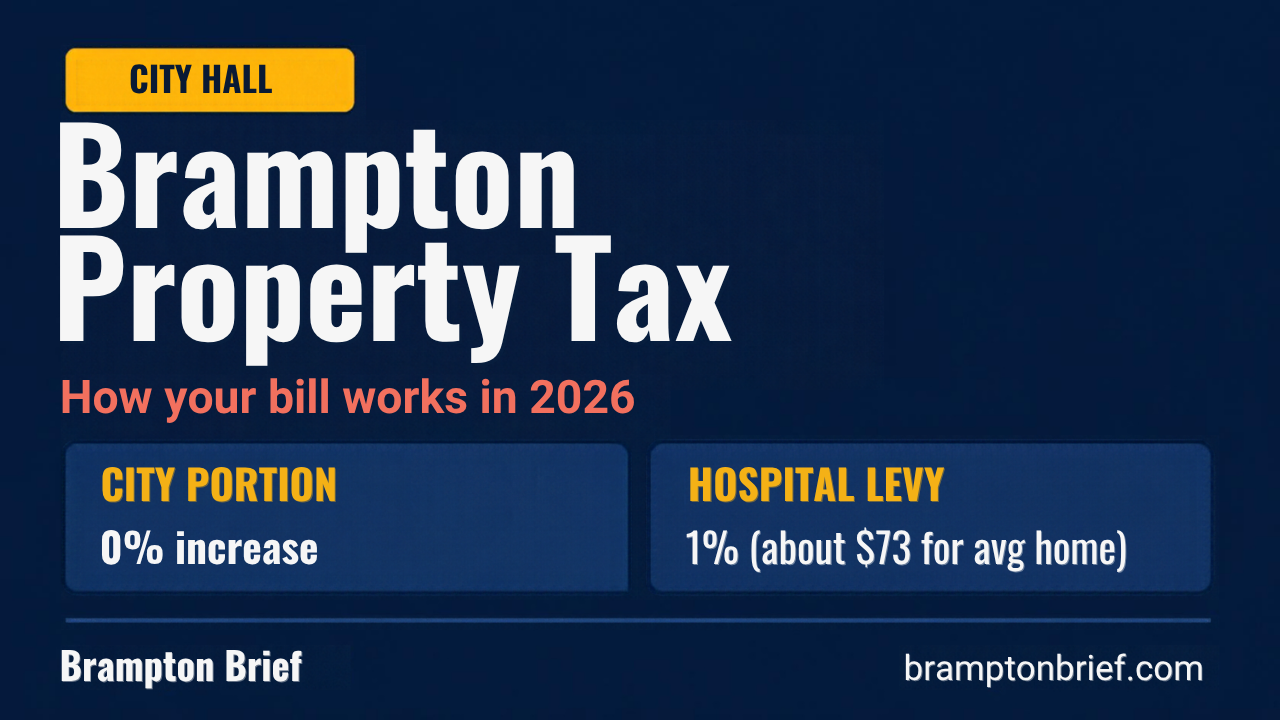
- For 2026, City Council approved a 0% increase to the City’s portion of the bill, plus a 1% hospital levy.
- The City says that adds up to about $73 more for the average Brampton home, assessed at $543,000.
- All three 2026 final instalments were due before the end of September. The next bill to expect is the 2027 interim bill, usually sent in January.
How the two bills work
The City of Brampton bills property taxes twice a year, and each bill is paid in three instalments.
The interim bill covers roughly the first half of the year. It is based on 50 per cent of the previous year’s taxes, adjusted for things like cancellations or supplementary taxes. It is usually mailed in January. For 2026 the instalments were due on February 18, March 18 and April 22.
The final bill covers the rest of the year. It reflects your updated assessment, any change in the City’s tax rate, and the education portion. Final bills go out in early summer, and the 2026 instalments were due July 22, August 19 and September 23. Whatever you paid on the interim bill is deducted from your year’s total, and the balance is your final bill.
Each instalment covers about two months of taxes. If a bill doesn’t reach you, you’re still responsible for paying it, and penalties can apply to late payments.
What is on your tax bill
Your property tax bill is not only for the City of Brampton. It combines:
- The City portion, which funds municipal services such as roads, parks, recreation, fire services and by-law enforcement
- The Region of Peel portion, which funds regional services
- The education portion, which is set by the province and goes to schools
Brampton Council sets only its own share. The Region and the province set theirs, which is why a “0% City increase” doesn’t mean your whole bill stays the same.
Where the number comes from: your assessment
Your tax is based on your property’s assessed value, multiplied by the tax rates. The Municipal Property Assessment Corporation (MPAC) values every property in Ontario, and the City uses that information to calculate your bill.
According to the City, assessments are updated every four years. Increases are phased in gradually over the four-year period, while decreases take effect immediately. If you disagree with your assessment, questions about it go through MPAC, not the City.
What the 2026 budget did
In February 2026, Brampton City Council approved its 2026 budget. The City’s budget news release describes the two key decisions:
- A 0% increase to the City’s portion of property taxes. The City says this keeps Brampton’s municipal tax rate among the lowest in the GTA, at $1,516 per person compared with a GTA average of $1,819, based on a 2025 BMA Municipal Study.
- A continued 1% levy for Brampton’s second hospital. This is a dedicated charge on the City portion of the bill.
Together, the City says these amount to an increase of about $73 for the average Brampton home. Under Brampton’s strong mayor powers, the mayor proposes the City budget each year.
Why a hospital levy?
Brampton is required to contribute $125 million to the William Osler Health System for the expansion of Peel Memorial into a second hospital. Mayor Patrick Brown has said, in an interview with CP24, that under the provincial funding formula the City pays 10 per cent of the construction cost and all of the equipment inside. He also said full construction was expected to begin in the summer and take about four to five years to finish.
A City staff report on the 2026 tax levy puts the total hospital levy for 2026 at about $20.3 million, including the existing base levy plus an additional amount to speed up funding. For an average home assessed at $543,000, that totals roughly $92 on the City portion of the bill. The $73 figure is the City’s estimate of the net increase from 2025, so the two numbers measure different things.
Supporters and critics
Supporters, including the Mayor and the Brampton Board of Trade, say the budget protects affordability while still funding services and the hospital. Polling at a City budget event also showed strong support for the hospital levy.
Critics argue that repeated tax freezes can leave gaps in infrastructure and transportation funding that later fall on homeowners, and that the City is asking for more over time through the hospital levy. Both views are part of the debate heading into the election.
How to pay your Brampton property tax
The City accepts several payment methods:
- Online, telephone or in-person banking. Use your 17-digit tax roll number as the account number, and add the City of Brampton as a payee.
- Pre-Authorized Tax Payment Plan (PTP). Money is withdrawn automatically from your bank account. The City says there is no fee to enrol. There are three options: monthly at the beginning of the month, monthly in the middle of the month, or six times a year on the instalment dates.
- Cheque, by mail or in person.
- Credit card, through a third-party service.
The City must receive your payment by the due date to avoid penalty and interest charges, so allow time for banking transfers to arrive. Full details are on the City’s property tax page.
What if you can’t pay or missed a payment?
If you think you missed an instalment, check your balance on the City’s My Property Tax service or contact Service Brampton at 311 (905-874-2000 from outside the city). The City’s tax page also lists information about rebates, new-homeowner questions and payment plans, so it is worth looking there before a balance grows.
What to expect next
- Early 2027: interim bills for 2027 are typically sent in January, with instalments in February, March and April. Check brampton.ca/tax for the exact dates once they’re set.
- The 2027 budget: the council elected on October 26, 2026 is expected to set it, so tax and spending priorities are likely to come up in the campaign. See our voting guide for dates and locations.
- Possible levy changes: the City has said the hospital levy may need to continue, so the amount in future budgets is worth watching.
Frequently asked questions
How often do I pay property tax in Brampton? There are two bills a year, interim and final, and each is paid in three instalments.
How is my interim bill calculated? It is based on 50 per cent of your previous year’s taxes, adjusted for any changes.
Did Brampton raise property taxes in 2026? Council kept the City’s portion at 0% but kept a 1% hospital levy. The Region of Peel and education portions are separate, and your total change depends on all parts of your bill.
Why did my final bill change from my interim bill? The final bill reflects your updated assessment and any changes in the City, Region and education portions, with your interim payments deducted.
What is the 17-digit roll number? It is the number on your tax bill that identifies your property account. You use it when paying through your bank.
Who do I contact about my assessment? MPAC handles assessment questions. The City handles billing and payments.
Can I spread payments across the year? Yes. The Pre-Authorized Tax Payment Plan lets you pay monthly or on the instalment dates.
This article is general information, not financial or legal advice. For official details, use brampton.ca/tax or call 311. Brampton Brief will update this guide when new bills and budget details are released.
1 thought on “Brampton Property Tax Explained: How Your Bill Works in 2026”
Comments are closed.